If You’re Reading This, You Probably Already Know the Real Problem Isn’t “Sleep”
You’re not here because you don’t know that sleep matters.
You’re here because despite knowing better, something still isn’t working.
- You wake up too early, too wired, or too mentally alert
- You fall asleep fine but wake between 2:30–4:00 AM
- Your Oura, Whoop, or Apple Watch shows inconsistent deep sleep
- You’ve tried supplements, routines, blackout curtains, apps
- You function… but not at the level you know you’re capable of
This page is not here to convince you that sleep is important.
You already know that.
This page exists to answer a harder question:
“Why hasn’t anything I’ve tried actually fixed this?”
The Core Insight Most Sleep Products Miss
Sleep failure in high performers is not a willpower issue, a discipline issue, or a supplement deficiency.
It is an environmental signal problem.
Your nervous system does not respond to intentions.
It responds to inputs.
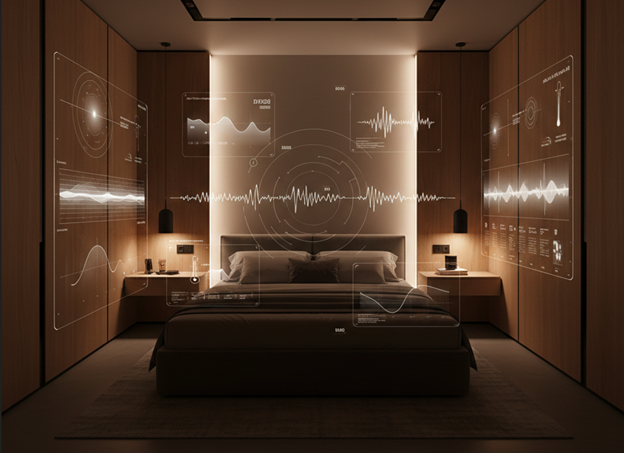
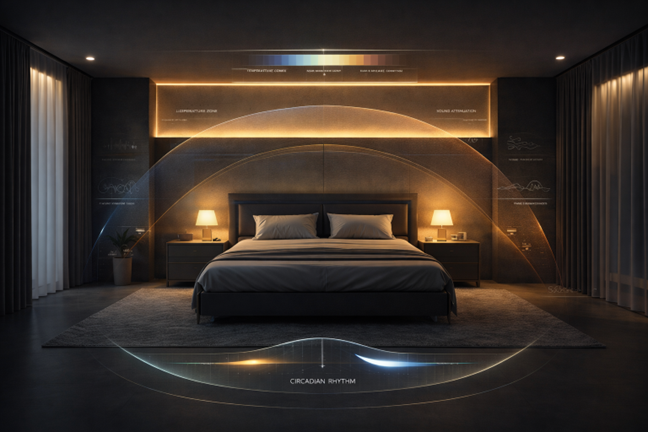
Light, temperature, EMF, sound frequency, air chemistry, visual contrast, spatial order these inputs continuously tell your brain whether it is safe to power down… or remain vigilant.
High-functioning brains are especially sensitive to these signals.
The better your cognition, the harder it is to “override” a misaligned environment.

Why High-Performers Wake Up at 3 AM (And Why It’s Not Stress Alone)
Between 2–4 AM, your body naturally transitions through a circadian checkpoint.
If your environment sends conflicting signals, your brain interprets this as a potential threat and releases cortisol even if your conscious mind feels calm.
Common triggers include:
- Inconsistent thermal gradients
- Artificial light bleed (even dim LEDs)
- EMF proximity
- Acoustic noise below conscious perception
- Visual clutter interpreted as “unfinished cognitive load”
This is why meditation, magnesium, or breathwork help temporarily but fail long-term.
They act downstream.
The problem originates upstream.
What The Sleep Sanctum™ Actually Is (And What It Is Not)
The Sleep Sanctum™ is not a single product.
It is a neuro-environmental system a deliberately engineered sleep architecture designed to:
- Remove contradictory sleep signals
- Reduce nocturnal cortisol activation
- Reinforce parasympathetic dominance
- Improve deep sleep consistency, not just duration
It does not rely on:
- Sedation
- Habit stacking
- Motivation
- Supplements as the primary mechanism
Instead, it works by changing what your nervous system experiences every night whether you’re thinking about sleep or not.

Designed Specifically for Analytical Minds
Most sleep products fail skeptics for one reason:
They ask for belief before evidence.
The Sleep Sanctum™ was built in reverse.
Design Principles:
- Mechanism-first (not testimonials first)
- Environmental causality (not motivation)
- Systems over hacks
- Removal of friction, not addition of effort
You don’t need to believe in it.
You need to understand it.
And once you understand it, belief becomes irrelevant.
How This Is Fundamentally Different From Other “Sleep Solutions”
|
Typical Sleep Product |
The Sleep Sanctum™ |
|
Single variable focus |
Multi-signal orchestration |
|
Treats symptoms |
Removes upstream triggers |
|
Relies on compliance |
Works passively |
|
Add more tools |
Remove conflicting inputs |
|
Short-term relief |
Long-term baseline shift |
This is why many customers report:
“I didn’t realize how compromised my sleep environment was until it wasn’t.”

“Will This Actually Work for Me?”
This is the most reasonable question on this page.
Here’s the honest answer:
If your sleep issues are caused by biological damage, severe medical conditions, or untreated sleep disorders, this is not a replacement for clinical care.
If your sleep issues are caused by:
- Environmental misalignment
- Cognitive hyper-arousal
- Circadian disruption
- High baseline alertness
Then this has a very high probability of impact.
Why?
Because your nervous system cannot ignore its environment.
“What If I Regret This Later?”
Regret comes from two things:
- Lack of understanding
- Lack of reversibility
The Sleep Sanctum™ addresses both.
- Every component has a clear mechanism
- No permanent modifications
- No dependency loops
- No artificial stimulation
This is not a gamble.
It’s a reversible systems upgrade.

“Is This Company Actually Trustworthy?”
You should not trust brands by default.
You should trust methodology.
Lux Smart Home Living designs for:
- High-performance professionals
- Skeptical decision-makers
- Long-term outcomes, not impulse sales
No discounts.
No artificial urgency.
No exaggerated claims.
If you need pressure to buy, this isn’t for you.
Why Buyers Choose This Anyway
Because once uncertainty is removed, price becomes secondary.
You’re not buying sleep accessories.
You’re buying:
- Cognitive reliability
- Emotional regulation
- Decision clarity
- Long-term performance stability
Sleep is not a lifestyle category.
It’s an operating system.

SCIENTIFIC REFERENCES & EVIDENCE BASE
(For readers who prefer data over claims)
The Sleep Sanctum™ was not designed around trends or anecdotes.
Its structure is informed by well-established research in sleep science, circadian biology, thermoregulation, environmental health, and neuroscience.
Below is a non-exhaustive overview of the scientific principles that guided its design.
1. Light Exposure, Circadian Rhythm & Melatonin Suppression
Key finding:
Light exposure, especially blue-weighted light directly suppresses melatonin and shifts circadian timing, delaying sleep onset and fragmenting sleep.
Relevant research & sources:
- Harvard Medical School – Blue light has a dark side
Demonstrates how short-wavelength light suppresses melatonin more strongly than other wavelengths and affects circadian rhythm timing. - Brainard et al., Journal of Neuroscience
Identifies wavelength-specific melatonin suppression in humans. - Chang et al., Proceedings of the National Academy of Sciences (PNAS)
Shows evening light exposure delays circadian phase and reduces sleep quality.
How this informs The Sleep Sanctum™:
Circadian light control is prioritized to reduce nighttime melatonin suppression and reinforce darkness cues allowing the brain to transition into sleep without resistance.
2. Thermoregulation & Sleep Architecture
Key finding:
A slight drop in core body temperature is required for sleep initiation and maintenance. Overheating or thermal instability increases awakenings and reduces deep sleep.
Relevant research & sources:
- Krauchi & Deboer, Sleep Medicine Reviews
Details the relationship between thermoregulation and sleep stage stability. - Okamoto-Mizuno & Mizuno, Journal of Physiological Anthropology
Demonstrates that elevated ambient temperatures impair sleep quality and increase wake episodes. - NIH / National Library of Medicine (PubMed Central)
Multiple reviews confirm temperature as a major environmental determinant of sleep continuity.
How this informs The Sleep Sanctum™:
Thermal management is treated as a core pillar, not an accessory supporting stable sleep stages by maintaining a consistent, cool sleep microclimate.
3. Air Quality, Respiratory Comfort & Sleep Health
Key finding:
Air pollution, allergens, and poor indoor air quality are associated with poorer sleep duration, increased sleep fragmentation, and reduced subjective sleep quality.
Relevant research & sources:
- American Thoracic Society – Air pollution and sleep health
Links particulate exposure with sleep disruption. - Billings et al., Sleep (Official Journal of the Sleep Research Society)
Identifies associations between environmental air quality and sleep outcomes. - NIH / Environmental Health Perspectives
Reviews connections between respiratory irritation, inflammation, and sleep disturbance.
How this informs The Sleep Sanctum™:
Clean air and respiratory comfort are addressed to reduce subtle physiological stress signals that keep the nervous system partially alert during sleep.
4. Noise, Sensory Input & Micro-Arousals
Key finding:
Even when sleepers do not consciously awaken, environmental noise and sensory disturbances can trigger micro-arousals that fragment sleep and reduce restorative depth.
Relevant research & sources:
- Basner et al., Sleep Medicine Reviews
Explains how environmental noise impacts sleep continuity and cardiovascular stress. - World Health Organization – Night Noise Guidelines for Europe
Establishes thresholds where noise begins to impair sleep health. - Dang-Vu et al., Nature Neuroscience
Demonstrates how the brain continues threat-monitoring during sleep.
How this informs The Sleep Sanctum™:
Sensory predictability and sound consistency are used to reduce subconscious threat scanning allowing the nervous system to remain in a parasympathetic (rest-and-repair) state.
5. Systems-Based Environmental Design vs. Single-Variable Interventions
Key finding:
Sleep is influenced by interacting environmental variables, not isolated factors. Addressing one input while others remain disruptive produces limited results.
Relevant research & frameworks:
- Spielman’s 3P Model of Insomnia (Predisposing, Precipitating, Perpetuating factors)
- Behavioral Sleep Medicine literature emphasizing environmental control
- Neurophysiology research on multisensory integration and autonomic regulation
How this informs The Sleep Sanctum™:
The system is designed to coordinate multiple sleep-relevant inputs simultaneously, increasing the probability of consistent improvement rather than partial relief.
Important Clarification
The Sleep Sanctum™ is not a medical device and does not claim to diagnose, treat, or cure sleep disorders.
It is an environmental optimization system designed to:
- Reduce known sleep disruptors
- Support the body’s natural sleep mechanisms
- Increase the likelihood of deeper, more continuous sleep
Individual results vary because biology varies.
Why We Share This
We believe confidence comes from understanding, not persuasion.
If you prefer to make decisions based on:
- Mechanisms instead of marketing
- Probability instead of promises
- Evidence instead of anecdotes
Then this system was built with you in mind.
EXPLORE THE SLEEP SANCTUM™ →
Designed around sleep science. Evaluated by experience.
🔗 https://luxsmarthomeliving.com/pages/the-sleep-sanctum

FREQUENTLY ASKED QUESTIONS
EVIDENCE-BASED ANSWERS TO REASONABLE QUESTIONS
“Isn’t sleep mostly psychological? Why focus on the environment?”
Sleep is not primarily a conscious behavior.
Decades of sleep research show that sleep onset and depth are governed by:
- Circadian signaling (light exposure)
- Thermoregulation (core body temperature)
- Autonomic nervous system state
- Sensory threat monitoring
These processes operate below conscious control.
That’s why research in circadian biology and behavioral sleep medicine emphasizes environmental control as a first-line intervention because the brain responds automatically to inputs whether you “believe” in them or not.
The Sleep Sanctum™ doesn’t try to change your mindset.
It changes the signals your nervous system is receiving.
“I already have good sleep habits. Why would this help?”
Good habits help but they don’t override contradictory environmental inputs.
You can:
- Go to bed on time
- Avoid caffeine
- Meditate
- Follow routines
…and still experience poor sleep if:
- Light suppresses melatonin
- The room overheats
- Air irritants activate the nervous system
- Noise causes micro-arousals
Research consistently shows that even disciplined sleepers experience fragmented sleep when environmental conditions are misaligned.
This system exists for people who already “do the right things” and still don’t sleep well.
“Does light exposure really matter that much?”
Yes and this is one of the most consistently replicated findings in sleep science.
Human circadian rhythms are light-driven, not habit-driven.
Research from institutions like Harvard Medical School, PNAS, and the Journal of Neuroscience shows:
- Blue-weighted light suppresses melatonin more strongly than other wavelengths
- Evening light exposure delays circadian phase
- Even moderate light can impair sleep onset and quality
This is why circadian lighting is treated as a foundational pillar, not a bonus feature.
The Sleep Sanctum™ minimizes disruptive light exposure, so the brain receives a clear and consistent “nighttime” signal.
“Is temperature really that important?”
More than most people realize.
Sleep initiation requires a slight drop in core body temperature.
When the sleep environment interferes with that process, sleep becomes lighter and more fragmented.
Peer-reviewed studies in Sleep Medicine Reviews and Physiological Anthropology show:
- Elevated ambient temperatures increase wake episodes
- Thermal instability reduces deep sleep continuity
- Overheating is a common cause of night awakenings
Many people blame stress or age when the real issue is sleep micro-climate.
The Sleep Sanctum™ treats temperature regulation as a structural requirement, not an afterthought.
“What about air quality? I don’t have asthma.”
You don’t need a diagnosed condition for air quality to matter.
Research in environmental health and sleep medicine shows that:
- Poor indoor air quality correlates with reduced sleep quality
- Particulates and irritants can increase physiological arousal
- Respiratory discomfort subtly activates the nervous system
Even low-grade irritation can keep the brain in a semi-alert state.
This system focuses on respiratory calm, not just breathing mechanics—because sleep depth depends on how safe the nervous system feels.
“Is sound masking or sensory control actually supported by research?”
Yes, but with nuance.
The brain continues monitoring the environment during sleep.
Sudden or unpredictable sensory input increases micro-arousal even if you don’t fully wake.
Research cited by the WHO and published in Sleep Medicine Reviews shows:
- Environmental noise fragments sleep architecture
- Micro-arousals reduce restorative sleep stages
- Consistent, predictable sound environments reduce disturbance
That’s why the Sleep Sanctum™ emphasizes sensory predictability, not just silence.
“Why not just use a wearable or sleep tracker?”
Wearables measure sleep.
They don’t fix what’s disrupting it.
Tracking without environmental correction often increases frustration:
- You see poor metrics
- You don’t know what to change
- You try random interventions
The Sleep Sanctum™ addresses root inputs first.
Track if you want but the goal is to need tracking less, not more.
“How do I know this will work for me specifically?”
You don’t at least not with absolute certainty.
And any product claiming otherwise isn’t being honest.
What is knowable:
- The system addresses well-documented sleep disruptors
- Improvements are measurable (latency, awakenings, sleep quality)
- The risk is capped by a 90-day performance guarantee
This is not about certainty.
It’s about probability alignment.
“What if my sleep issues are stress-related?”
Stress doesn’t exist in isolation it expresses itself through physiology.
Environmental safety cues:
- Reduce autonomic arousal
- Lower baseline nervous system activation
- Make stress less likely to interrupt sleep
Many users report that stress feels “less intrusive” once the environment stops amplifying it.
The system doesn’t eliminate stress, but it stops the bedroom from adding to it.
“Why is this a system instead of a single product?”
Because sleep fails systemically.
Research models like the 3P Model of Insomnia (predisposing, precipitating, perpetuating factors) show that sleep disruption persists when multiple inputs reinforce each other.
Single-variable solutions rarely resolve persistent sleep problems.
The Sleep Sanctum™ was designed to:
- Remove multiple disruptors simultaneously
- Prevent one fix from being undermined by another problem
- Create consistent biological signaling
That coordination is the value.
“Is this a medical treatment?”
No.
The Sleep Sanctum™:
- Does not diagnose
- Does not treat medical conditions
- Does not replace professional care
It is an environmental optimization system.
For many people, that distinction matters because they don’t want medication, escalation, or dependency. They want conditions that allow the body to function as designed.
A Final Thought for Skeptical Minds
You don’t need to believe in the Sleep Sanctum™.
You only need to accept one idea:
Biology responds to inputs, whether we think about them or not.
This system simply aligns those inputs.
Everything else follows naturally.
REVIEW THE SLEEP SANCTUM™
Built for people who think before they buy.
🔗 https://luxsmarthomeliving.com/pages/the-sleep-sanctum
Final Thought
You don’t need to buy this today.
You don’t need to buy it at all.
But once you understand why your sleep hasn’t responded to effort, it becomes difficult to unsee.
If you’re ready to stop managing symptoms and start removing causes,
The Sleep Sanctum™ exists for that exact moment.

If what you’ve read resonates if you’re tired of waking up wired instead of restored there is a complete solution designed specifically for this problem.
The Sleep Sanctum™
👉 Transform Your Bedroom into a Sleep Sanctuary
🔗 https://luxsmarthomeliving.com/pages/the-sleep-sanctum
The Sleep Sanctum™ is a neuroscience-backed sleep environment system designed to eliminate the exact triggers that cause 3 a.m. wake-ups.
- Circadian light disruption
- Temperature instability
- Air quality stress
- Sensory overload
Instead of chasing sleep with hacks, it redesigns your bedroom to keep you asleep.
Add a Sleep Optimization Checklist PDF or Jet-Lag Reset Protocol for travelers and executives