
You’re not bad at sleeping.
You’re overstimulated, over-signaled, and overloaded.
And no amount of “go to bed earlier” advice fixes that.
The Sleep Sanctum™ was designed for a very specific person:
Someone who performs at a high level during the day…
Carries responsibility that doesn’t turn off at night…
And feels wired but tired even when their body is begging to shut down.
This is not a sleep product.
It’s a recovery environment engineered for nervous systems that never fully power down.
If This Sounds Familiar, You’re in the Right Place
- You fall asleep exhausted, yet wake up feeling unrefreshed
- Your mind stays active long after your body is ready to rest
- Sleep trackers say you slept but your brain disagrees
- You’re productive, capable, disciplined… and quietly depleted
- Weekends don’t reset you anymore
You don’t need motivation.
You need physiological permission to recover.
🔍 Why Burned-Out High Performers Struggle with Sleep (Even When They “Do Everything Right”)
Burnout isn’t laziness.
It’s chronic nervous system over-activation.
High performers live in:
- Continuous cognitive demand
- Artificial light after sunset
- Constant decision-making
- Persistent stress hormones
- Irregular circadian signaling
Your body adapts by staying alert even when you lie down.
Over time, your sleep becomes:
- Shallow instead of deep
- Fragmented instead of continuous
- Restorative in theory, not in reality
This is not a willpower issue.
It’s an environmental mismatch.

Why Most Sleep Solutions Fail High Performers
Most products target sleep symptoms, not sleep signals.
- Supplements try to force sedation
- Apps track problems instead of fixing them
- Mattresses improve comfort, not neurobiology
- Meditation helps but only after the system is ready
High performers don’t need more tools.
They need less friction between their nervous system and rest.
That’s where The Sleep Sanctum™ is fundamentally different.
What the Sleep Sanctum™ Actually Does
The Sleep Sanctum™ is a designed recovery environment not a gadget, not a pill, not a promise.
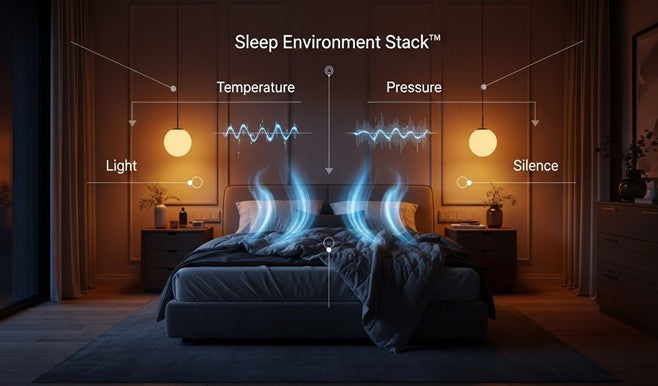
It works by removing the signals that keep your nervous system on alert and reintroducing the signals your biology expects at night.
It aligns three critical systems:
- Circadian signaling (light, darkness, timing)
- Autonomic regulation (stress vs. recovery state)
- Cognitive shutdown (mental quiet without force)
This allows sleep to happen naturally, not chemically.

Built for People Who Can’t Afford Trial-and-Error
If you’re reading this, you’ve probably already tried:
- Sleep supplements
- Blue light glasses
- Meditation apps
- New routines that didn’t stick
- “Sleep hygiene” checklists
The frustration isn’t that you haven’t tried.
It’s that none of them solved the root problem.
The Sleep Sanctum™ was built for people who:
- Want predictable recovery, not hope
- Value systems over hacks
- Don’t want another thing to manage
- Need results without cognitive effort
“Will This Actually Work for Me?”
That’s the right question.
The Sleep Sanctum™ doesn’t rely on belief.
It relies on biology that doesn’t change just because you’re stressed or skeptical.
Human sleep is regulated by:
- Light exposure
- Environmental cues
- Nervous system state
- Consistency of signals
The Sanctum aligns without asking you to do more.
If your body is capable of sleep, it is capable of responding to the right environment.

“What If I Regret This Later?”
Regret usually comes from uncertainty, not cost.
Uncertainty about:
- Whether it was designed for your situation
- Whether it addresses causes, not symptoms
- Whether the company understands high performers
The Sleep Sanctum™ wasn’t designed for the general population.
It was designed for people who:
- Carry responsibility into the night
- Can’t “just relax” on command
- Need sleep to support performance, not replace it
This is not indulgence.
It’s maintenance for a system under continuous load.
Why This Is Not Comparable to Cheaper Alternatives
Cheaper options optimize components.
The Sleep Sanctum™ optimizes the system.
- It integrates environment, behavior, and biology
- It removes friction instead of adding routines
- It works passively, night after night
High performers don’t need novelty.
They need consistency that compounds.

This Isn’t About Sleeping Longer
It’s About Waking Up Recovered
Imagine waking up without:
- Mental residue from yesterday
- The sense that rest didn’t “take”
- The need to compensate with caffeine
Not because you forced it.
But because your system finally stood down.
That’s what real recovery feels like.
Is Now the Right Time?
Burnout doesn’t resolve itself.
It either deepens or gets addressed.
The Sleep Sanctum™ is for the moment when you decide:
“I’m done running my nervous system on overdraft.”
No urgency.
No pressure.
Just clarity.

SCIENTIFIC REFERENCES & EVIDENCE BASE
Why the Sleep Sanctum™ Works for Burned-Out High Performers
Burnout-related sleep disruption is not a motivational problem and not a discipline problem.
It is a well-documented neurobiological state driven by chronic stress, circadian disruption, and environmental mismatch.
The Sleep Sanctum™ is built on established, peer-reviewed research across five domains:
1. Burnout, Stress, and Nervous System Dysregulation
Burned-out high performers exhibit chronic sympathetic nervous system activation, even at night. This prevents full entry into deep, restorative sleep stages.
Key findings:
- Chronic stress elevates nighttime cortisol, delaying sleep onset and reducing slow-wave sleep
- Burnout is associated with impaired parasympathetic recovery
- Cognitive load alone can maintain physiological arousal during rest periods
Foundational Research:
- McEwen, B. S. (1998). Protective and damaging effects of stress mediators. New England Journal of Medicine
- McEwen, B. S. & Stellar, E. (1993). Stress and the individual. Archives of Internal Medicine
- Grossi et al. (2015). Stress-related exhaustion disorder. Frontiers in Psychology
Relevance to Sleep Sanctum™:
The Sanctum is designed to down-shift autonomic tone through environmental signaling rather than relying on cognitive effort or sedation.
2. Circadian Rhythm Disruption in High-Performance Lifestyles
High performers are disproportionately exposed to circadian misalignment due to artificial lighting, late-night screens, and irregular cognitive demand.
Key findings:
- Evening light exposure suppresses melatonin and delays circadian phase
- Circadian misalignment reduces sleep efficiency even when total sleep time appears adequate
- Cognitive performance declines despite “normal” sleep duration
Foundational Research:
- Czeisler et al. (1999). Stability, precision, and near-24-hour period of the human circadian pacemaker. Science
- Chang et al. (2015). Evening use of light-emitting devices impacts sleep. PNAS
- Wright et al. (2013). Entrainment of the human circadian clock. Current Biology
Relevance to Sleep Sanctum™:
The Sanctum restores proper circadian signaling by controlling evening light spectra, timing cues, and environmental contrast allowing sleep pressure to work as intended.
3. Environmental Cues and Sleep Architecture
Sleep quality is heavily influenced by non-conscious environmental inputs, not just comfort or routine.
Key findings:
- Light, temperature, sound, and spatial cues influence sleep depth and continuity
- Environmental inconsistency fragments REM and deep sleep
- Passive environmental control outperforms active behavioral interventions
Foundational Research:
- Okamoto-Mizuno & Mizuno (2012). Effects of thermal environment on sleep. Journal of Physiological Anthropology
- Muzet (2007). Environmental noise, sleep, and health. Sleep Medicine Reviews
- Walker, M. (2017). Why We Sleep. (Synthesizes decades of sleep research)
Relevance to Sleep Sanctum™:
The Sanctum functions as a biological signal optimizer, not a comfort upgrade reducing micro-arousals and improving sleep continuity.
4. Cognitive Hyperarousal and “Wired-But-Tired” Insomnia
Burned out professionals often experience psychophysiological insomnia, where mental activity sustains physiological alertness.
Key findings:
- Cognitive load alone can elevate heart rate and cortisol at night
- Insomnia in high performers is frequently driven by anticipatory cognition, not anxiety disorders
- Environmental safety cues reduce pre-sleep cognitive activation
Foundational Research:
- Riemann et al. (2010). Hyperarousal and insomnia. Sleep Medicine Reviews
- Harvey (2002). A cognitive model of insomnia. Behavior Research and Therapy
- Perlis et al. (1997). Psychophysiological insomnia. Sleep
Relevance to Sleep Sanctum™:
By reducing environmental ambiguity and sensory noise, the Sanctum lowers the brain’s need to stay vigilant without forcing mental techniques.
5. Recovery, Performance, and Long-Term Health
Sleep is not just rest, it is neurobiological maintenance for cognition, emotional regulation, and resilience.
Key findings:
- Chronic sleep fragmentation mimics cognitive aging
- Deep sleep is essential for emotional processing and stress recovery
- Recovery capacity directly predicts long-term performance sustainability
Foundational Research:
- Lim & Dinges (2010). A meta-analysis of sleep deprivation and neurobehavioral functioning. Psychological Bulletin
- Van der Helm et al. (2011). Sleep deprivation impairs emotional regulation. Current Biology
- Åkerstedt et al. (2014). Burnout and sleep. Journal of Psychosomatic Research
Relevance to Sleep Sanctum™:
The Sanctum is designed to protect recovery capacity, not merely reduce symptoms supporting sustained performance over time.
Summary for the High Performer
Burnout-related sleep problems are predictable, measurable, and biologically reversible when the environment stops signaling threat and overload.
The Sleep Sanctum™ does not introduce new effort.
It removes the conditions that prevent recovery.
This is not an experiment.
It is an application of established science to a modern performance problem.

FAQ FOR BURNED-OUT HIGH PERFORMERS
Evidence-Based Answers for People Who Don’t Buy on Hope
“I’m exhausted, but I still can’t shut my brain off at night. Why?”
Because exhaustion and sleep readiness are not the same biological state.
Research on burnout and stress physiology shows that chronic high performers often experience persistent sympathetic nervous system activation, even when physically tired. Elevated nighttime cortisol and autonomic arousal keep the brain in a monitoring mode, not a recovery mode.
This is well documented in:
- Stress and allostatic load research (McEwen)
- Hyperarousal models of insomnia (Riemann, Perlis)
How the Sleep Sanctum™ addresses this:
Instead of trying to mentally “calm down,” the Sanctum removes environmental threat and stimulation cues, allowing the nervous system to down-regulate automatically. No effort required.
“I sleep for 7–8 hours. Why do I still feel unrefreshed?”
Because sleep duration ≠ sleep quality.
Studies on circadian misalignment and burnout show that:
- Fragmented sleep reduces slow-wave (deep) sleep
- Circadian disruption impairs recovery even when time-in-bed looks normal
- Wearables often overestimate restorative sleep
This pattern is common in high performers with irregular light exposure and late cognitive demand.
How the Sleep Sanctum™ addresses this:
The Sanctum improves sleep architecture, not just total sleep time by restoring circadian signals and reducing nighttime micro-arousals that prevent deep recovery.
“I’ve tried supplements and sleep aids. Why don’t they solve this?”
Because most sleep aids force sedation, not recovery.
Clinical sleep research shows that:
- Sedatives do not replicate natural slow-wave sleep
- Many suppress REM or fragment sleep cycles
- They bypass the root cause: environmental and autonomic dysregulation
This is why many high performers “sleep” but don’t recover.
How the Sleep Sanctum™ addresses this:
The Sanctum does not chemically override your nervous system.
It restores the conditions under which your biology initiates sleep naturally.
“Is this just another expensive sleep product with nice design?”
No and this is an important distinction.
Most sleep products optimize comfort or convenience.
The Sleep Sanctum™ optimizes biological signaling.
Environmental sleep research shows that light spectrum, thermal stability, sound consistency, and spatial cues directly influence:
- Melatonin release
- Sleep continuity
- Nervous system vigilance
How the Sleep Sanctum™ differs:
It integrates these signals into a coherent recovery environment, rather than offering isolated upgrades (a mattress, a lamp, an app).
“What if my insomnia is severe or long-standing?”
Environmental correction is often the first-line recommendation before escalating to pharmacological or clinical interventions.
Sleep medicine literature shows that:
- Chronic insomnia is frequently maintained by environmental and cognitive hyperarousal
- Reducing nighttime vigilance cues can restore sleep without forcing behavior change
How the Sleep Sanctum™ fits:
It does not conflict with medical care.
It supports the same biological mechanisms clinicians aim to restore without adding cognitive workload.
“How long does it take to notice a difference?”
Circadian and autonomic systems respond faster than most people expect once signals are corrected.
Research on circadian entrainment shows that:
- Melatonin timing can shift within days
- Sleep continuity often improves before total duration
- Cognitive quieting precedes “perfect sleep”
What most users notice first:
- Faster mental shutdown
- Fewer nighttime awakenings
- A different quality of morning alertness
This is recovery returning, not being forced.
“What if this works for others but not for me?”
That question usually means: “Is my situation different enough that biology won’t apply?”
Unless your sleep issue is caused by a rare neurological condition, your sleep is governed by:
- Circadian rhythms
- Autonomic balance
- Environmental input
These mechanisms are not personality dependent.
How the Sleep Sanctum™ avoids this risk:
It doesn’t rely on belief, discipline, or motivation only on biological response to signal correction.
“Is this something I’ll need to actively manage?”
No.
Burned-out high performers fail with solutions that:
- Add routines
- Require consistency
- Depend on motivation
Environmental interventions succeed because they work passively.
The Sleep Sanctum™ is designed to:
- Remove effort
- Reduce decision fatigue
- Work in the background, night after night
“Is this indulgent or actually necessary?”
Burnout research is clear on one point:
Recovery capacity determines long-term performance more than effort.
Chronic sleep disruption is associated with:
- Cognitive decline
- Emotional blunting
- Reduced stress resilience
The Sleep Sanctum™ is not a luxury upgrade.
It’s preventive maintenance for a system under continuous load.
Final Reframe for the Burned-Out High Performer
You don’t need to try harder to sleep.
You don’t need more tools.
You don’t need another routine.
You need an environment that stops telling your nervous system to stay alert.
That’s what the Sleep Sanctum™ was designed to do.

Final Thought
You don’t need to try harder to sleep.
You need an environment that tells your body it’s safe to stop.
That’s what the Sleep Sanctum™ was built to do.
When recovery becomes automatic,
performance takes care of itself.

If what you’ve read resonates if you’re tired of waking up wired instead of restored there is a complete solution designed specifically for this problem.
The Sleep Sanctum™
👉 Transform Your Bedroom into a Sleep Sanctuary
🔗 https://luxsmarthomeliving.com/pages/the-sleep-sanctum
The Sleep Sanctum™ is a neuroscience-backed sleep environment system designed to eliminate the exact triggers that cause 3 a.m. wake-ups.
- Circadian light disruption
- Temperature instability
- Air quality stress
- Sensory overload
Instead of chasing sleep with hacks, it redesigns your bedroom to keep you asleep.
Add a Sleep Optimization Checklist PDF or Jet-Lag Reset Protocol for travelers and executives.